To some people, Agenda 21 is an evil plan for the further creation, and control, of a world government, by the non-elected bureaucrats at the United Nations. To other people, Agenda 21 is a just well-meaning, harmless, non-binding set of recommendations, created by a group of men, and women, at the United Nations, that care about the preservation of the world's environment.
Before debating the true intentions, or effects, of Agenda 21, we must first understand the details of this document.
In can be difficult, and confusing, for the average person who hears about Agenda 21, to really understand it, through a simple search. The program is hundreds of pages, and not too many people will take the time to read all of it. An internet search of UN Agenda 21 will lead to a lot of information, but much of it is without reference to the actual document, thus seemingly just an opinion. I have took the time to read the document myself, and will chronicle my findings, and thoughts, here.
(It should be noted that I am not going into this examination completely ignorant of Agenda 21. I have, in the past, written critically about
events taking place in my local community, that are connected to United Nations Agenda 21.)
The full document is 351 pages, however Agenda 21 is much more complex than just what is written in this action plan, due to the fact that there are numerous other resolutions referenced, and recommended, for further implementation, such as the Healthy Cities Programme of WHO, the Convention on the Rights of the Child, and many more. I have yet to read all of these other resolutions, conventions, and programs, but as I do, I will document, and update, my research, at
TheGoodmanChronicle.com. For now, I will just examine the text of this specific document, which can be viewed, in full, online
here.
Let us start with the front cover of the hard copy version of Agenda 21 (picture below), which reads:
"EARTH SUMMIT - AGENDA 21 - THE UNITED NATIONS PROGRAMME OF ACTION FROM RIO".
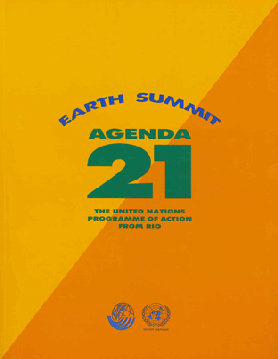 |
| Agenda 21, Front Cover |
By using the words "programme of action", the creators of this document are informing the reader that this is a plan, or program, that they intend to have performed, or put into action, and not just some ideas that they hope for people to consider.
Agenda 21 is broken up into forty chapters, divided into three sections, and nearly every part of this document revolves around the idea of creating, what they refer to as, "a new global partnership for sustainable development." (Chapter 1, Section 1). Though the adjective "sustainable" is used numerous times, and in conjunction with various other pleasant sounding nouns, to create ideas like "sustainable livelihood" (Ch. 3, Sec. 4-a), and "sustainable city networks" (Ch. 7, Sec. 20-d), throughout Agenda 21, what is meant by "sustainable" is never really made clear, or specifically defined.
The opening preamble of Agenda 21 alludes to the idea that the term "sustainable development" means an "integration of environment and development concerns", which, according to the United Nations, will lead to "the fulfilment of basic needs, improved living standards for all, better protected and managed ecosystems and a safer, more prosperous future." (Ch. 1, Sec. 1) This sounds nice, but again, is not specific, and could mean anything.
As the reader progresses through the document, a more sinister, controlling, agenda seems to emerge, that is ingrained in this plan, but it is masked with nice sounding phrases, and friendly language. The United Nations claims to want to create a sort-of utopia, where the environment is clean, nobody is hungry, everyone has a home, etc., but to do this, they need to have the power to create laws, or recommendations, that effect changes in your local community.


 Licensing Parents is a book written by a professor of psychiatry named Jack Westman, which attempts to convince the reader that if the government required parents to be "licensed" before they were allowed to have children, it would result in fewer cases of child abuse and neglect. Exploring and analyzing the concepts put forth in this book are important as there are people in positions of power that take this book, and concept, seriously. One of those people is former judge for the Litchfield District Superior Court in Connecticut, Charles D. Gill. Gill wrote the foreword to Licensing Parents, and says that this was the book that convinced him that parents should be licensed. The influence of Judge Charles Gill in Connecticut law and politics was briefly explored in the article Parents Beware: The United Nations Looking To Give Children of Connecticut Special "Rights". This influence of Judge Gill deserves a more in-depth critical analysis, but for the sake of brevity, we will just focus on the concepts presented in Licensing Parents by it's author, Jack Westman.