Showing posts with label Communism. Show all posts

Wednesday, May 6, 2015

Connecting the Ford Foundation to the Implementation of Agenda 21 in Connecticut

Much has been written on the Ford Foundation, and its influence, past, and present, on American society.  References to various literature on the Ford Foundation will be listed throughout this analysis, and readers should follow those references if interested in gaining a greater understanding of the foundation.  The purpose of this analysis is to focus specifically on the Ford Foundation's connections to UN Agenda 21, and its implementation in the state of Connecticut.

As detailed in the report A Critical Analysis of Agenda 21 - United Nations Program of Action, Agenda 21 is a collectivist plan for world government, based on the concept of "sustainable development".  The concept of sustainability and sustainable development was brought into the public debate in 1987 with the publication of the Our Common Future report.  This report lists The Ford Foundation as a significant financial contributor. (For a more detailed explanation of the Our Common Future report, and how it relates to United Nations Agenda 21, read A Brief Examination of "Our Common Future": The Report That Gave Birth To Agenda 21)

Another direct connection of Agenda 21 to the Ford Foundation comes from the Foundation's open support of civil society organizations (CSO's) that advance "the sustainable development conventions associated with the 1992 Earth Summit", the event where Agenda 21 was introduced.

In an effort to make this analysis easy to follow, various aspects of Agenda 21 will be broken down into categories, the connection to the Ford Foundation of each of these categories will be discussed, and later a description will be given of how it is being implemented in the state of Connecticut.

World Government 

Long before Agenda 21 was introduced, plans for world government have been discussed by various people, and organizations.  In relation to the Ford Foundation, the idea of a world government was propagated by former associate director of the Ford Foundation, Robert Hutchins.

The views and influence of Robert Hutchins deserve their own in-depth analysis, especially when discussing the Ford Foundation connection to United Nations Agenda 21, but for the sake of brevity we will just briefly discuss his legacy.  Robert Hutchins served in various influential positions in American society including President of the University of Chicago, associate director of the Ford Foundation, and chairman of the Fund for the Republic.  Hutchins was a proponent of world government, and while serving as President of the University of Chicago, was the head of the Committee to Frame a World Constitution.  This is how the Chicago Tribune, in 1948, described Hutchin's World Constitution:
"The 'declaration of duties and rights' of this world constitution, which is not called a 'bill of rights,' does not even mention freedom of speech or of the press, guaranteed in the 1st amendment to the United States Constitution, nor does it enumerate more than two of the 22 specific items of freedom, or limitations upon government, established in the first ten amendments which make up the American Bill of Rights.
Along with the 'duties,' which limit the 'rights' in the Hutchins committee's draft, is the declaration that all property, including private property, 'is the common property of the human race,' and that private property shall be subordinated to "the common good," which is to be established by the new 'world government'."
In the book The Ford Foundation: The Men and the Millions, author Dwight MacDonald discusses how some Americans threatened to boycott Ford cars because they considered the Ford Foundation to have a "liberalistic flavor", and viewed Robert Hutchins, and former President of the Ford Foundation, Paul Hoffman, as "wild-eyed One Worlders".  MacDonald also discusses how some of the Ford Foundation trustees found various decisions by Hoffman to be objectionable:
"Some of the trustees are also said to have objected to Hoffman's "controversial" personal activities, such as his enthusiasm for the United Nations and UNESCO, his support of ex-Senator Benton when the latter was sued by Senator McCarthy, and his politicking to win the Republican nomination for Eisenhower. " (pg. 149)

Monday, March 23, 2015

A Critical Examination of the Book and Concept of "Licensing Parents"


Jack Westman, author
of Licensing Parents
Licensing Parents is a book written by a professor of psychiatry named Jack Westman, which attempts to convince the reader that if the government required parents to be "licensed" before they were allowed to have children, it would result in fewer cases of child abuse and neglect.  Exploring and analyzing the concepts put forth in this book are important as there are people in positions of power that take this book, and concept, seriously.  One of those people is former judge for the Litchfield District Superior Court in Connecticut, Charles D. Gill.  Gill wrote the foreword to Licensing Parents, and says that this was the book that convinced him that parents should be licensed.  The influence of Judge Charles Gill in Connecticut law and politics was briefly explored in the article Parents Beware: The United Nations Looking To Give Children of Connecticut Special "Rights"This influence of Judge Gill deserves a more in-depth critical analysis, but for the sake of brevity, we will just focus on the concepts presented in Licensing Parents by it's author, Jack Westman.

There is great deal of information presented in this nearly 300 page book, a lot of which is easy to agree with.  For example, it does not take a trained psychiatrist to see that there are problems in society, and that many of the functions that are supposedly set up to fix these problems, are not working.  Westman begins his book mentioning some of these issues such as "widespread crime", "the abduction of children", and an increase in suicide among teens.  It is not so much Westman's diagnosis of society's problems that deserve scrutiny, but his radical solutions to these problems.  Before exploring Westman's proposed solutions, though, it is important to understand what he believes to be the causes of societies ills.

Wednesday, November 19, 2014

A Brief Examination of "Our Common Future": The Report That Gave Birth To Agenda 21

To understand the complexity of the United Nations Agenda 21 Program of Action, a serious study needs to be conducted not only of the Agenda 21 plan itself, but also of the various reports, conventions, treaties, etc., that are referenced throughout Agenda 21 literature.  The World Commission on Environment and Development, also referred to as the Brundtland Report, or "Our Common Future", is one of the essential reports, related to the Agenda, that needs to be read, to further develop an understanding of the ideas, and goals, of the planners, who are implementing this massive agenda for the world.  (To view the 300-page online .pdf version of Our Common Future, off of the United Nations website, click here.)

According to the description on the back cover of the hard copy version of "Our Common Future":
"The World Commission on Environment and Development, headed by Gro Harlem Brundtland, Prime Minister of Norway, was set up as an independent body in 1983 by the United Nations.  Its brief was to re-examine the critical environment and development problems on the planet and to formulate realistic proposals to solve them, and to ensure that human progress will be sustained through development without bankrupting the resources of future generations"
We know this report played a key role in the creation of Agenda 21, from references to it, in various Agenda 21 affiliated literature.  For example, in the Introduction section of the children's version of Agenda 21, Rescue Mission: Planet Earth, the Brundtland Report, Our Common Future, is credited with "set[ting] out the idea of Sustainable Development."  Of course the term 'sustainable development' is key, as nearly every chapter of the Agenda 21 Program revolves around the idea of creating, what they refer to as, "a new global partnership for sustainable development."

Another example to show this report's connection to Agenda 21 comes from a newsletter released by a highly-influential organization in the area of regional planning, the American Planning Association (APA).  In an article titled, How Sustainable Is Our Planning?, land use planner Robert Odland, discusses the origins of the term 'sustainable development', how it is being used more frequently by planners, and it's connection to Agenda 21.
"[A] new family of terms is appearing more frequently in planning : sustainable development, sustainable cities, and sustainable growth.  What do these terms mean and what are the implications for planners?   The concept of sustainability and sustainable development came into the public debate with the publication of the World Commission on Environment and Development report, Our Common Future, (often known as the Brundtland Report).  This report defined sustainable development as the ability to meet the needs of the current population without compromising the ability of future generations to meet their own needs."
Continuing with the article written by Robert Odland in the APA newsletter, Odland goes on to explain the connections with sustainability and Agenda 21:
"Vice President Gore’s book, Earth in the Balance addressed many of the general issues of sustainability. Within the past year, the President’s Council on Sustainable Development has been organized to develop recommendations for incorporating sustainability into the federal government. Also, various groups have been formed to implement Agenda 21, a comprehensive blueprint for sustainable development that was adopted at the recent UNCED conference in Rio de Janeiro (the ‘Earth Summit.’).”
Providing a full, detailed analysis of Our Common Future, would be a futile task, as nearly every concept proposed in this report, is also proposed in Agenda 21, and the report A Critical Analysis of Agenda 21 - United Nations Program of Action does a sufficient job of describing, and analyzing, those key concepts.  It is important, though, to highlight certain excerpts, and details of the Brundtland report, that may help in providing a greater understanding of the overall Agenda.

There were 21 members on this commission, all representing different countries, including such prominent figures as the previously mentioned former Prime Minister of Norway, Gro Harlem Brundtland, former EPA administrator and FBI director, William Ruckelshaus, and Canadian businessman Maurice Strong.  Another notable member of the Commission, representing Guyana, is Shridath S. Ramphal, who is quoted in the children's version of Agenda 21 promoting population control, and criticizing anti-abortion groups like the Catholic Church.  Separate, extensive studies should be conducted on the different members of the Commission, especially on Gro Brundtland and Maurice Strong, to find various interesting connections, but for the sake of brevity, we will move on from looking at the particular members of the commission.

Friday, August 22, 2014

Go To Work and Give The Government Your Children: The Feminist UN Agenda 21 Plan To "Empower" Women

The original intention in writing this analysis was simply to discover the reason that the role of women seemed to be such a vital part of United Nations Agenda 21.  As one connection led to another, I found myself with a massive amount of information, all of which important, and necessary, to explain what is happening in terms of the manipulation of women in today's society.  This is my attempt to condense all of that information into a reasonably short overview.  The reader should understand that there is much more to this story, and can follow any of the many links, and sources, provided in this analysis, if they want to learn more.

Upon my first complete reading of United Nations Agenda 21, the UN's plan for the world for the 21 century,  I noticed how nearly every chapter of the Agenda curiously emphasized the necessary role of women in the implementation of the plan.  Of course, implying that women play a major role in society is not, in itself, odd in any way, however the manner in which these ideas are presented, I did find questionable.  Aside from recommending governments implement strategies to increase the amount of women in positions of "decision makers, planners, managers, scientists and technical advisers", the agenda also wants to have influence in people's lives at home by looking to "promote the reduction of the heavy workload of women and girl children at home", and, somehow, influence "the sharing of household tasks by men and women on an equal basis."  Reducing the number of children that women have was another concept continuously discussed as a matter of importance in the Agenda.  (Sidenote:  For more information on the actual Agenda 21 document, I highly recommend reading my article A Critical Analysis of Agenda 21 - United Nations Program of Action)

At first, I just kept the Agenda's emphasis on women as a mental note, as there were seemingly more important aspects of Agenda 21 to discuss, and analyze.  However, as I began to read more UN books, and documents, an anti-men/pro-women agenda seemed to emerge.  For example, in the children's version of Agenda 21, Rescue Mission: Planet Earth , a book promoted by the United Nations, former executive of the United Nations Population Fund, Dr. Nafis Sadik, is asked the question "There's a lot in Agenda 21 about women playing a critical role in population, but aren't men usually the problem?", and her response was:
"Yes - there's a lot of male authority but not much male responsibility in relation to child bearing.  Men are not burdened with the problem of giving birth, they tend to exploit children -sending them to work instead of investing in their education. What can children do? They should challenge their parents not to have any more children until they can look after them properly." [emphasis added]
Aside from the blatant, and in my opinion, unjustified, attack on men, the idea that children are being exploited by their family reminded me of a quote from the Communist Manifesto:
"Do you charge us with wanting to stop the exploitation of children by their parents?  To this crime we plead guilty" - The Communist Manifesto 
These type of quotes, and concepts, compelled me to re-examine Agenda 21, and find a possible origin to these ideas.  The full Agenda 21 document, in book form, is 351 pages, however Agenda 21 is much more complex than just what is written in this action plan, due to the fact that there are numerous other resolutions referenced, and recommended, for further implementation.  One such resolution that is recommended for implementation is the Nairobi Forward-looking Strategies for the Advancement of Women report.  When I decided to look into, and read, this report from Nairobi, I discovered a feminist agenda, with dubious objectives.  (For a greater understanding of the objectives discussed in the Nairobi report, read my article A Critical Summary of the Nairobi Forward-looking Strategies for the Advancement of Women)

In the following examination, I will be making connections with this Agenda 21-related report, and current events that are taking place, as well as the people, and organizations, causing these events to take place.

Thursday, July 17, 2014

Ten Documentaries about Communism, Ancient Civilizations, Fluoride, Cultural Marxism, and more

This is a random collection of ten documentaries, with my description of each.  I post a different documentary, every time I watch a new one.  To prevent the documentary page from taking an extremely long time to load, I create separate pages for older documentaries.  This is page 8.

The Soviet Story (added 07/13/14)

The Soviet Story is a look into the brutality, propaganda, and reign, of the Soviet Union.  This film covers various Soviet atrocities, such as the extermination of the Ukrainians of 1932-'33, through deliberate starvation.  This documentary also makes the case that there was little difference between German National Socialism (Nazism), and Soviet Communism, this point even being admitted to by high level leaders of both parties.  The propaganda of both of these regimes is compared, and there is an obvious relation.  Other topics of discussion include: Zyklon B, George Bernard Shaw, Trotsky's assassination, Soviet aggression against Finland, and much more.  One major problem with this documentary, or at least the version that I have seen, is that a good amount of the documentary is in a foreign language, with no subtitles.  I managed to sit through this inconvenience, but would not expect many other people to do so.


Monday, January 6, 2014

Ten Documentaries about African History, Assassinations, Communist China, Medicated Children, Saddam Hussein, Royalty, and more

A random collection of ten documentaries, with my description of each.  I post a different documentary, every time I watch a new one.  To prevent my documentary page from taking an extremely long time to load, I create separate pages for older documentaries.  This is page 4.

Mao Zedong and China's Cultural Revolution (added 12/10/13)

This film briefly chronicles the rise of Mao Zedong as the leader of Communist China from 1949-1976, including the alliance, and eventual denouncement, of the Soviet Union, as well as the denouncement, and eventual alliance, with the United States, during the Nixon administration, through Henry Kissinger. Chairman Mao Zedong encouraged the collectivization of privately held land, and incredible footage shows Chinese peasants beating, and yelling at, former land owners, denouncing them as "capitalist exploiters."  This 45-minute documentary is not the most entertaining film, but gives an interesting short glimpse into this period of Chinese history.


Friday, November 1, 2013

A Critical Analysis of Agenda 21 - United Nations Program of Action

To some people, Agenda 21 is an evil plan for the further creation, and control, of a world government, by the non-elected bureaucrats at the United Nations. To other people, Agenda 21 is a just well-meaning, harmless, non-binding set of recommendations, created by a group of men, and women, at the United Nations, that care about the preservation of the world's environment.

Before debating the true intentions, or effects, of Agenda 21, we must first understand the details of this document.

In can be difficult, and confusing, for the average person who hears about Agenda 21, to really understand it, through a simple search.  The program is hundreds of pages, and not too many people will take the time to read all of it.  An internet search of UN Agenda 21 will lead to a lot of information, but much of it is without reference to the actual document, thus seemingly just an opinion.  I have took the time to read the document myself, and will chronicle my findings, and thoughts, here.

(It should be noted that I am not going into this examination completely ignorant of Agenda 21.  I have, in the past, written critically about events taking place in my local community, that are connected to United Nations Agenda 21.)

The full document is 351 pages, however Agenda 21 is much more complex than just what is written in this action plan, due to the fact that there are numerous other resolutions referenced, and recommended, for further implementation, such as the Healthy Cities Programme of WHO, the Convention on the Rights of the Child, and many more.  I have yet to read all of these other resolutions, conventions, and programs, but as I do, I will document, and update, my research, at TheGoodmanChronicle.com.  For now, I will just examine the text of this specific document, which can be viewed, in full, online here.

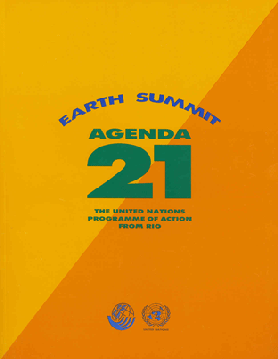
Let us start with the front cover of the hard copy version of Agenda 21 (picture below), which reads:
"EARTH SUMMIT - AGENDA 21 - THE UNITED NATIONS PROGRAMME OF ACTION FROM RIO".  
Agenda 21, Front Cover
By using the words "programme of action", the creators of this document are informing the reader that this is a plan, or program, that they intend to have performed, or put into action, and not just some ideas that they hope for people to consider.

Agenda 21 is broken up into forty chapters, divided into three sections, and nearly every part of this document revolves around the idea of creating, what they refer to as, "a new global partnership for sustainable development." (Chapter 1, Section 1).  Though the adjective "sustainable" is used numerous times, and in conjunction with various other pleasant sounding nouns, to create ideas like "sustainable livelihood" (Ch. 3, Sec. 4-a), and "sustainable city networks" (Ch. 7, Sec. 20-d), throughout Agenda 21, what is meant by "sustainable" is never really made clear, or specifically defined.

The opening preamble of Agenda 21 alludes to the idea that the term "sustainable development" means an "integration of environment and development concerns", which, according to the United Nations, will lead to "the fulfilment of basic needs, improved living standards for all, better protected and managed ecosystems and a safer, more prosperous future." (Ch. 1, Sec. 1)  This sounds nice, but again, is not specific, and could mean anything.

As the reader progresses through the document, a more sinister, controlling, agenda seems to emerge, that is ingrained in this plan, but it is masked with nice sounding phrases, and friendly language.  The United Nations claims to want to create a sort-of utopia, where the environment is clean, nobody is hungry, everyone has a home, etc., but to do this, they need to have the power to create laws, or recommendations, that effect changes in your local community.